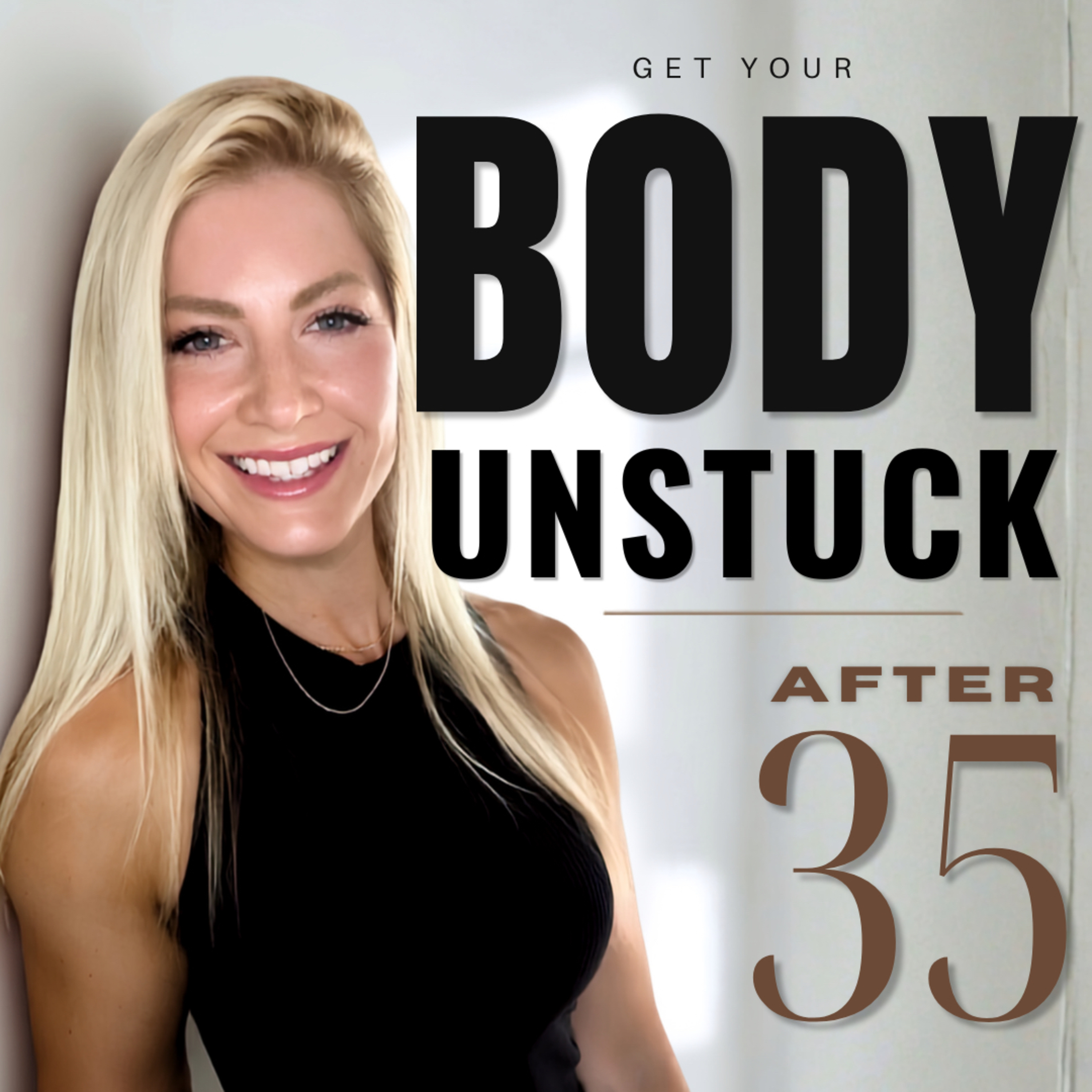
Calorie Deficit for Women Over 35: Why You’re Doing It Wrong
About this episode
How to Be in a Calorie Deficit Without Losing Muscle (Women 35+)
“Why does it matter what I’m eating if ultimately it only matters how much I’m eating?”
If a calorie deficit is just eating less than you burn… shouldn’t all calories work the same?
Not exactly.
In this episode, I break down how to be in a calorie deficit without losing muscle, and why so many women end up looking “skinny fat” instead of toned after dieting.
We cover:
Weight loss after 35 vs body recomposition
Why eating less alone isn’t enough
Calorie deficit for women over 35
How to lose fat without losing muscle
Why protein intake matters more after 35
Metabolism changes after 35
Why strength training for women is non-negotiable
The truth about macros for fat loss
Why some women aren’t losing weight in a calorie deficit
Here’s the reality:
Yes, fat loss requires a calorie deficit.But what you cut determines what you lose.
If protein is too low and strength training is missing, up to 20 - 39% of weight loss can come from lean muscle. That’s how women end up smaller, softer, and confused - even though the scale moved.
If protein is high and lifting is consistent, your body is far more likely to pull energy from stored fat instead of muscle. That’s body recomposition.
I’m currently operating on a waiting list for RAC Elite coaching spots. If you’d like to be added, please complete the attached initial client consultation form. This same form is used for both the RAC Elite coaching waitlist and the $59 Custom Macro Formulation.
When you submit it, please indicate in the notes section (or in your email) whether you’re interested in a coaching position or the custom macro formulation.
The difference between fat loss vs weight loss
Why “eating less” doesn’t automatically mean “looking better”
How to structure a calorie deficit strategically
Why macros matter for women over 35
How to protect metabolism while dieting
If you’re tired of:
Eating in a calorie deficit but not looking toned
Losing weight but not loving your shape
Wondering why dieting worked in your 20s but not now
Feeling like your metabolism slowed down after 35
This episode will clarify the science without the confusion.
00:00 – The common frustration: “I’m in a calorie deficit… so why don’t I look better?” Why eating less doesn’t automatically lead to a toned physique after 35.
03:10 – What a calorie deficit actually is (and what it isn’t) Calories in vs calories out explained clearly for women over 35.
06:45 – Weight loss vs body recomposition Why shrinking is not the same as sculpting.
10:20 – The “skinny fat” problem How low protein + no lifting causes muscle loss in a deficit.
14:15 – How much muscle you can lose while dieting The science behind lean mass loss and metabolism slowdown.
17:40 – Why protein matters more after 35 How higher protein intake helps preserve muscle and support fat loss.
20:30 – Structuring a calorie deficit correctly How to reduce calories without sacrificing muscle.
23:00 – Real example: Maintenance vs 20% deficit How to manipulate macros strategically instead of cutting blindly.
25:30 – The bottom line: Structure over starvation How to lose fat without losing muscle (and without wrecking your metabolism).
A calorie deficit is necessary.But structure is what changes your body.
Again, if you want your customized macro breakdown based on your body, lifestyle, and training, email me at [email protected] for your $59 Custom Macro Formulation, or connect with me on Instagram @RACfitness_ for more practical, science-backed strategies
Welcome back ladies. Today is deficit day and I have deviated from my normal podcast schedule with all my topics outlined to address it because I received the best comment slash question from this woman on Spotify and if you want to take a peek at it, it's on there also. I love your comments and questions please put them on Spotify or Apple podcast. That way everybody can see them. But she is expressing how confusing deficits were. She was like, so let me get this straight, I need to be in a deficit, but I have to eat a ton more protein.
And she touched on lifting and cardio and how it was so convoluted. And she's absolutely right. I wanted to do this entire episode in kind of a new context, which is I'm just going to draw an analogy between calorie deficits and a business. I really want to simplify it in a way that is more comprehensible. Ultimately, what I hear from women and what I was so confused with when I started really paying attention to my macros was if I have to be in a deficit, which is you are eating less than it takes to maintain your body, why does it matter what I'm eating if ultimately it just matters how much I'm eating?
For example, one of my one of my first clients, her and I would just go toe to toe on this. She would say things like I'm going to fast for whatever it was, maybe 18 hours or something. That really helps me. Well, yes, because you're in a deficit. So you're really shortening that window that you have to eat. And by default you're going to eat less than you would if you had an entire day to eat. So you might on a normal day, eat 20, five, 2800 calories. If you were doing intermittent fasting and maybe per SE, only allowing yourself to eat 4 hours, four hours out of the day.
Yeah, I assume you're not going to eat 20, five, 2800 calories. That's how it works. And if you did, you wouldn't lose any weight doing the fast. That's how it works. You're in a deficit. By the way, please do not intermittent fast if you are a woman, especially a woman above the age of 35. In one of my other episodes, I talk about fasting versus eating windows and how fasting is incredibly detrimental to your Physiology as a woman. We are not made for it. Men, they can do it. It's beneficial for them.
Us. No, we are not. As Doctor Stacey Sims says, we are not small men. OK, let's get into the deficit, how it works and why it matters what you are cutting out. I scribbled at the top of my paper when I started writing this episode a few days ago, restructuring the company. Because to me, restructuring a company is kind of the same as having body recomposition. We are changing what our body is made of. We are changing what our company is made of. We're restructuring both of them. So in this episode I am going to be comparing restructuring a company or a business to your body.
We are going to be referring to our fictional character named Sarah, and Sarah is in the process of restructuring her company. Sarah is wanting to not abandon the company because she loves the company. The company has done such amazing things for her over the years. The company sacred and strong and unique, and it is incredibly special because there's no other company like Sarah's. So we just want to give that company a completely new structure. We want it to be more efficient. We want it to be stronger.
We want it to be more resilient, brilliant to stress, illness, aging, you name it. As soon as we can figure out how to restructure the company, that company is basically rewinding itself age wise. Just like your body. When you can figure out the macro formula for you, your body will look better, will be stronger, will function more efficiently than you ever imagined possible. And you know what's important? Because you've noticed the company is not growing at the same rate that it used to. Just like your body, you might not be putting on muscle the way that you used to.
If you're above the age of 35. I promise you, you're not. Because if you haven't increased your body's weight training, then your body is losing. I think it's point 1% of muscle per year after age 35. So you're not imagining things when you look in the mirror and you're wondering to yourself, why does everything hang 1/2 inch lower than it did just a few years ago? And part of that is just aging. You can't stop your skin from losing elasticity. You can't. And that's totally fine. I actually like the fact that when I look in the mirror, I have really deep smile lines.
I don't dislike it. I I like the fact that you can tell I am a smiley, loud person because I wear it on my face. But what I don't like, and what I know most women do not like, is that they feel weaker. Simple tasks they remember doing even a handful of years ago are much harder. The clothes they wore their entire lives suddenly do not fit, despite the fact that you are eating pretty much the same way that you've eaten your entire life. That's not in your head. That's an actual physiological change that your body is going through around age 35.
And Despite that being a physiological shift that you cannot stop, there are things you can do to combat that and make your body, your business, even stronger than it's ever been before, look better than it's ever looked before. And when I say that, I mean that because I will be 38 in May. I have never been more strong than I am now in my entire life. And I was also a personal trainer in college. I have done figure shows, but now how? With the way that I lift, the way that I eat, the way that I train, my body is smaller, more toned, and best of all, stronger than it's ever been in my entire life.
Because while we love our bodies, we honor our bodies, we love our business. We honor our business, right? We know that there are things we can do to make the business better, stronger, more resilient. Just like we know there are things that we can do to our body to do all the aforementioned things, stronger, more resilient, and honestly, ageless. Because when you have muscle tone on your body and you're not sporting the skinny fat physique that you're barely scrounging by to maintain as is, if you have actual muscle visible on your body that is youthful.
So let's get into restructuring the company, AKA restructuring your body by going over what a calorie deficit is. Because when you have this company and you look at it from a different perspective one day and you see that it is slower, it's inefficient, you know, it doesn't look as good. It's kind of, you know, behind the times. It needs an upgrade. The 1st thing that goes through your head is you need to make budget cuts. The first thing that goes through your head when you look in the mirror or when you're sitting in your car stewing on how your body used to be is I need to cut calories.
And if you've gone down the road of cutting your calories, then I'm sure you know what a calorie deficit is. But in case you do not know what a calorie deficit is, it is just using more energy than you're eating. So when I say energy, that means calories. Basically, it means eating less food than your body needs, needs to maintain its current state of body fat, muscle and otherwise. So you have to be eating less than your body is using. That's a calorie deficit. So as we go forward in restructuring the company and we decide we need to make budget cuts.
Just like as you go forward, you make the decision, yeah, it's time to make a change. You're going to start cutting calories. You're going to go into a calorie deficit. We need to figure out what does that mean? Because if you blindly take, take your body and say I need to lose weight, well, you go online, you find your little total daily energy expenditure intake calculator and you figure out you're eating roughly 2500 calories per day. And then you go on there and you type in, you know, how many weeks is it going to take me to lose 8 lbs?
OK, well now you find I got to put myself in a 20% deficit and you just cut, you cut 500 calories from your 2500 calories that your body needs to maintain its current state. Great. We're on this same page here, but this is often where my clients and I have to have some science time because they will say, oh, I want to lose 8 to 10 lbs over the course of the next 8 weeks. And I will say of what? Because if you just do a 20% deficit and you go down to 2000 calories per day and you stay at your current activity level, yes, you will drop 8 to, in theory, 8 to 10 lbs over the course of those eight to 10 weeks.
But you're just going to have the exact same body that you had prior, only smaller. You didn't pay attention to what employees you were cutting. Just like in a company, if you make a 20% cut across the board and you just cut randomly 20% out, you're going to cut some of the employees you need. You're going to cut some of the employees that make the company run. Your company is going to be the exact same inefficient company that you had a problem with in the 1st place, only smaller. Just like your body.
If you cut 20% of your caloric intake off and you lose weight, your body is going to look the exact same as it does now, but a little smaller and a little looser to be honest because you didn't pay attention to where you made the calorie cuts, you just cut the calories. And this is where I often, from my own experience as well, we'll use the term skinny fat because yes, you got skinnier, but still, when you look in the mirror, it's not as exciting as you might have assumed it would be because your body has just become a skinnier version of what you deemed to be unappealing to begin with.
And that's not what your body needs to be its healthiest, strongest self. That's not what your company needs to be its healthiest, strongest self. We don't need to make a blanket 20% cut. We need to be more intentional about that. So let's get into those calories, those employees, and we're going to break them into three groups. You have your protein, your carbs, and your fats. Those three groups are macro nutrients. There are only three macro nutrients. The alcohol is technically a fourth. We're not getting into that.
There's only three macro nutrient groups that all foods have within them. Some have really high protein, medium fat, low carb, that's my ideal. Some have really high carbs, no protein, a lot of fat. Those are usually your shelf happy ones, you know, cupcakes, whatnot. Let's start with my favorite group of employees. We have the pro team and you like that protein, protein. So protein, that's your pro team. That is the infrastructure. Foods that are high in protein, those are the ones that build your body, they build the muscle.
That's your construction crew, your your maintenance. They are what makes your body firm and strong. We need a good pro team. You need a lot of people ideally in the protein, so you need to be thinking about that when you're eating. Most women who are trying to drop fat while maintaining or building muscle, they are going to need their total daily intake around can be anywhere from 27 to 40% of it should be from protein. That's a lot of protein for most women that's probably around 110 to 180 hundred 90 grams of protein per day.
Most women do not eat over 50 grams of protein per day. But if you want a strong company, if you want a strong muscular toned body, you need to bump up your protein. That's where you're going to pour a ton of assets and intention and time behind getting more employees that will be part of the pro team. You want more of the protein in your body as well, and it takes the same intention. You the protein requires a lot of preparation. It costs more. You have to to really be deliberate in getting protein into your body.
It's something you plan for, just like getting those employees that will be your pro team. They don't walk through the door every day. You have to really go out and find them, devote a lot of time and resources into keeping them happy and to keeping those employees on board. It's it takes a lot. I know protein's not fun to prep twice a week. Protein's not the tastiest thing on earth. I get it. It's expensive. What do you want? Do you want to stay the same, or do you want to do what it takes to make the changes you want to see?
Because it's going to take you having a lot bigger protein than you have for your company as it stands. OK, So we're talking about making that 20% cut, cutting those employees by 20%. And as we know, not all employees are created equal, just like calories. Not all calories are created equal. The quality of them is better in some than others, just like employees. So we covered the protein and I think I said 25, you could say 27 to 40% of your daily intake should come from protein. If you are trying to drop fat.
Let's get into the carbs. So carbs they are, they are the personality higher. Are any of you those? I've been those before or just once in my life when I worked at a bank. Unfortunately for the bank carbs, they're operations, they create the energy. There are the fun ones that are just, you know, they're happy to be there and you're happy they're there too because they taste good. And a lot of times they're inexpensive. They make you happy just being around them. I mean, that's how I feel when I'm around carbs.
Fats too. So carbs, they are important. You need those people with the bright personalities that make work a fun place to be. Just like eating carbs, you know, my carbs are always the favorite spot on my meal unless I'm eating steak. And I would say most women probably need around like 30 to 35% carbs of their daily intake. And please take these numbers not super seriously because everybody is so different in the way their body processes carbs. I do custom macro formulations and I have a series of three quizzes that was from a program I had purchased a while back and it is so spot on.
It will identify women who have Hashimoto's when they didn't tell me they had Hashimoto's or put it in their notes and that we'll pull that out so women handle carbs differently. Please. Maybe I'll just stop saying percentages and you can, you can contact me. I'll do your custom macro formulation or you can look it up online easily too. There's some pretty good tools out there. The point being, you need carbs. You don't need a ton of them, but you do need them. That's where you're going to be making a lot of cuts because in the business more often than that you have hired too many carbs, right?
That's honestly that is that is where a lot of womens''s calorie abundance is coming from is the carbs and the fats. But just like a business, a lot of times you just have to cut the fluff and you know, you have maybe too many people working from home who aren't so much working anymore, or you have those people who are doing jobs that now ChatGPT took over. So it's time to make some cuts. And a lot of your cuts are going to come from your carb area. Unfortunately. Now the last macro nutrient, the last group of employees we're going to cover are the fats.
And they're they're the long term reserves. They're the ones we have to have just in case we need them. They're storage, they're security, and they're really great to have. They're a necessity. We just don't need a lot of them. Now, as I said, where most women and men make the mistake is they will go into that 20% calorie deficit and they will cut the budget blindly. They're they're just making that 20% cut across the board. And more often than not, protein is what gets cut out and you're left with carbs and fats.
Because we did not look at who we were cutting. We didn't look at the departments. We just looked at the total spending. So yes, as I said, the company shrinks, your body shrinks. But now since we've blindly made this big calorie cut, our infrastructure is weaker. Just like your muscles are now depleted, your performance drops, your metabolism adapts, your whole shape softens, It's a smaller company, it's a smaller body. But as I said, it is not the one that you were aspiring to have. And that's not recomposition, that's not restructuring the company, that's just downsizing.
And that is not strategic because recomposition is strategic restructuring. We want to protect the pro team. And honestly, you are going to have to pour more investments into your protein. We have to reduce the operations and re reduce the fat reserves. So carbs and fats are primarily where you're going to make your cuts and put all your investments into getting more pro team. Now again, body recomposition is very different from losing weight. Losing weight, you're making a blind budget cut body recomposition, you are strategically restructuring your body and we're not punishing your body by taking those carbs and fats down a little bit.
We are just tightening the body. We're tightening the company. We're going to become leaner, we're going to become stronger. And again, I want to reiterate this. That's the difference between losing weight and looking toned body recomposition versus losing weight, skinny fat versus toned strategy versus blind cut. OK, so let me use my company's number. I think I might have called myself Sarah in the beginning, but it's actually my number. So my maintenance, my company's full operating budget is around 2500 calories per day.
OK, I just started my gradual cut for summer. So I have this gradual summer cut and this for this example, I'm doing a 20% one. I'm going to make a 20% cut of my 2500 calories that my body needs to just maintain. So if I keep doing what I'm doing, lifting the way I lift, eating the way I eat, and I'm sitting at 2500 calories, my body's not going to gain or lose. But if I make a 20% cut from that and now I'm at 2000 calories per day, now I'm going to drop some weight. That's that's the law of thermodynamics.
So energy cannot be created or destroyed. It can only be transferred or stored. So if you consistently eat less than what your body needs, your body is going to pull it from somewhere. And we want it to pull that energy from our fat stores. And we can make it do that. We can make our body pull that energy that it needs. Because remember, we went in a 500 calorie deficit. My body's like, hey, I need some more energy. Where am I going to get it? Well, if I did a blind cut and just cut the 500 calories without taking into consideration what I'm cutting, it's going to get it from my lean muscle first.
That's where it's going to take it 40% of it about. But here is the key. Now here's where you need to listen. I'm not cutting everything equally. I am going to allocate about 40% of my total, that calorie intake to protein. That's around like 190 grams of protein. Now that's for my body specifically, not yours, maybe yours, I don't know. These are specific numbers for my macro formulation. I have been lifting over 15 years. I lift around six days per week. I do multiple multiple sessions of zone 2.
I'm at around 15,000 steps a day. I have about 6768 lbs of muss on me. That's my Physiology. So these numbers are for me. If you want help with your numbers I can help you. My notes have my e-mail address in it, but just for the sake of this episode I want to reiterate that. So a 5 foot one lady is not going to be eating 200 grams of protein. Please don't do that, OK? So here's the key. I have 40% of my total daily intake calories coming from my protein. OK, now I've got about 170 grams of carbs and 60 grams of fats to play with.
In total that's 2000 calories. That is strategic because if I run that for about 6 weeks and if I really eat on point, I am going to drop about 3 to 4 lbs of fat. I didn't say wait, I said fat. Now if you look on my Instagram and Scroll down a couple rows a few months ago I did just a mini cut to showcase this science exactly. My Instagram is RAC fitness under score. RAC fitness under score. I ate on point for a month, think I was eating about 1800 calories. I did it for a month so it's kind of a drastic cut and I showed I believe I lost 5 lbs of fat and you can see it.
It looks like maybe I lost to an untrained eye 10 lbs to for me and I laid out the science it would incomplete with my embodies. You can see that my my weight loss primarily came from fat and I did that by manipulating the amount of protein, carbs and fats that I was eating every day to meet my goal. My goal was to drop fat and gain or maintain my muscle. So I did that by having about 40 grams of protein and dilly dallying with the carbs and fats. Simply put, but I had to stay at 2000 calories. I had to stay at that.
I did not go above. So while you have that 2000 calories to work with, 40% of those calories have to be protein. You can play with the rest depending on your body, but 40% of that for me has to be protein. That's how you actually manipulate your body into using primarily fat for the energy that it will draw upon when you who are in a calorie deficit. That was kind of long winded. This whole episode is supposed to be 5 minutes, but I just loved comparing a body to a business. And I also want to reiterate that that is honoring your body.
That's honoring your business because it's slow and it's it's controlled and it's structural and your body's not going to be smaller and softer. It's going to be leaner and stronger because we are not punishing the company. We're restructuring it. And that distinction matters especially for women who are above the age of 35, because our goal isn't to be weak and flabby. Our body is doing a great job of that as it is. We want to rebuild it. Now. If you want help with your custom macro formulation, I do those.
I have a tiny wait list to wait right now. I think it'd be like 4 days if I can get when I can get to it. But if you are interested in getting that customized macro formulation, it's a series of three quizzes. All you have to do is shoot me an e-mail. RAC Fitness MN. So RAC Fitness MN like [email protected]. And really helpful. I did two of them today and they're just, they're fun to do because I love having these back and forth with you guys and just kind of identifying the things I see in your lifestyle which are pointed out in the first quiz.
And I'm not mean at all, but we are going to have a fax, a fax based conversation via e-mail and it's the two page PDF. It does take me a few days to crank it out because I've said this before, I just like to make it cute. It's nice to look at when it's nice to look at. So if you need help with your custom macros, e-mail me [email protected]. Otherwise, you can check out my Instagram. I have a lot of fun teaching tools on there. Just kind of document my life as a almost 38 year old mom of three who's just trying to build muscle, being a muscle mommy.
OK, Thank you so much for tuning in ladies, and you will hear from me again next week. Oh, quick plug, before I forget, I said this in the last episode, but if you have questions or comments for me, please put them in Spotify or an Apple podcast because so many of you have the same questions and comments. And most of you e-mail me because I get it. You want that degree of anonymous animated nominee. I can't say it, you know you want to be anonymous, but there is no bad question except for the one unasked.
Please ask them on Spotify or Apple Podcast. Thanks again ladies, and we'll talk soon.
 Apple Podcasts
 Castbox
 Castro
 Goodpods
 Moon FM
 Overcast
 Pocket Casts
 Podbean
 Podcast Addict
 Podcast Republic
 Spotify